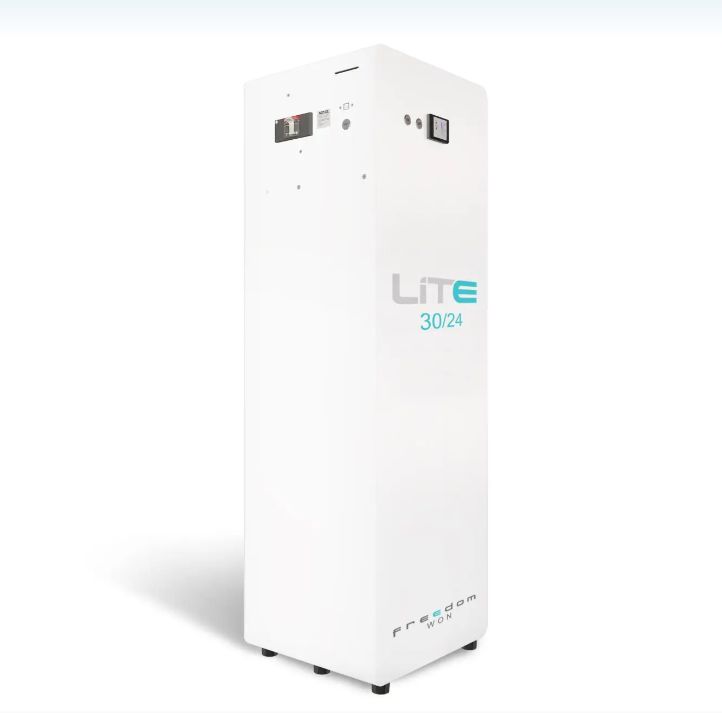
This Freedom Won Lite Home LiFePO4 battery is the perfect high quality battery for all your residential and industrial solar solutions. The range is from 5KWh to 30KWh batteries.
Features and Functions
This battery is compatible with most inverters on the market
10-year local manufacturer’s warranty
Support high discharge and charge power
Batteries can be charged in shorter time due to high charge capability
1)DoD =Depth of Discharge,recommended 80% DoD for average daily discharge,70% DoD on average for optimal life–max for normal operation 90% DoD,max for system in standby100% DoD.
2)Maxloadduration-30secondsper40secondcycle.1.5xMaxoverloadcanbehandledfor5seconds.
3)FlyLeads1,8mlong,power cable Red=Positive,Black=Negative,conductors in table refer to one electrode i.e.per positive and negative connections.
4)End of Life(EoL) defined as cell dropping to 60% of Beginning of Life (BoL) capacity for expected life and 70% of BoL capacity for warranty.
LiTE Home 30/24
Total Energy Capacity [kWh] 30
Energy, 80% DoD [kWh] 24
Energy, 90% DoD [kWh] 27
Current Capacity [Ah] 600
Max & Cont. Charge Current [A] 600
Max & Cont. Charge Power [kW] 30
Max/Cont. Discharge Current [A] 750/600
Max/Cont. Discharge Power [kW] 38/30
Nominal Voltage [V] 52V, to suit 48V Inverters, min 47V, max 56V
Max Recommended Inverter Total Rated Power (cont.) [kVA] 25
Short Circuit Current [kA] 12
Battery dimensions – H x W x D [mm] 1300x413x370
Crated dimensions – H x W x D [mm] 1396x586x568
Battery Weight [kg] 254
Crated Weight [kg] 293
DC Connection – Fly Leads (no. per electrode) [mm²] 2x95mm² Permopower
Enclosure
Aluminium enclosure painted white, for use indoors or fully protected under-cover environments, rated to IP20
Protection
Shunt Trip Circuit Breaker sized to suit max current, can be tripped by BMS if critical fault, manual reset. Includes overcurrent, cell under and over voltage, temperature, weak cell detection, minimum SoC control
Control Interface
USB Serial protocol for troubleshooting & RJ45 for BMS & inverter communication
Human Interface
State of Charge display (0 to 100%), Error light, Error Reset button, USB plug for programming
Warranty
Standard Warranty: 10 years (or 6000 cycles) 80% DoD, 0.5C Max Discharge, 0.25C Max Charge, Max 25°C
Service Life
>16 years (>5 500 cycles) expected life at 80% DoD 1 >20 years (>7 500 cycles) at 50% DoD
Essential Accessories
Note that for connecting the battery to a PC a USB “printer” cable is required (one is supplied with each battery), CAN Bus Termination Resistor – one required per battery (one included with battery), CAN Bus cable (RJ45 LAN cable) – one required per battery (not supplied with battery). Note some inverters will require a special (non-standard pin configuration) cable – see installation manual.